The 10th Workshop on Domain-Specific Modeling

Reno/Tahoe, Nevada, USA
17-18 October 2010
Workshop has now finished. You can view the papers, presentations and
group work results.
The 10th Workshop on Domain-Specific Modeling |
|
|
|
Reno/Tahoe, Nevada, USA |
Domain-specific modeling (DSM) provides a modern solution to demands for higher productivity by constricting the gap between problem and solution modeling. In the past, productivity gains have been sought through new programming languages. Today, domain-specific modeling languages provide a viable solution for continuing to raise the level of abstraction beyond coding, making development faster and easier.
In DSM the models are constructed using concepts that represent things in the problem domain, not concepts of a given programming language. The modeling language follows the domain abstractions and semantics, allowing developers to perceive themselves as working directly with domain concepts. The models represent simultaneously the design, implementation and documentation of the system, which can be generated directly from them. In a number of cases the final products can be automatically generated from these high-level specifications with domain-specific code generators. This automation is possible because of domain-specificity: both the modeling language and code generators fit the requirements of a narrowly-defined domain, usually inside a single organization.
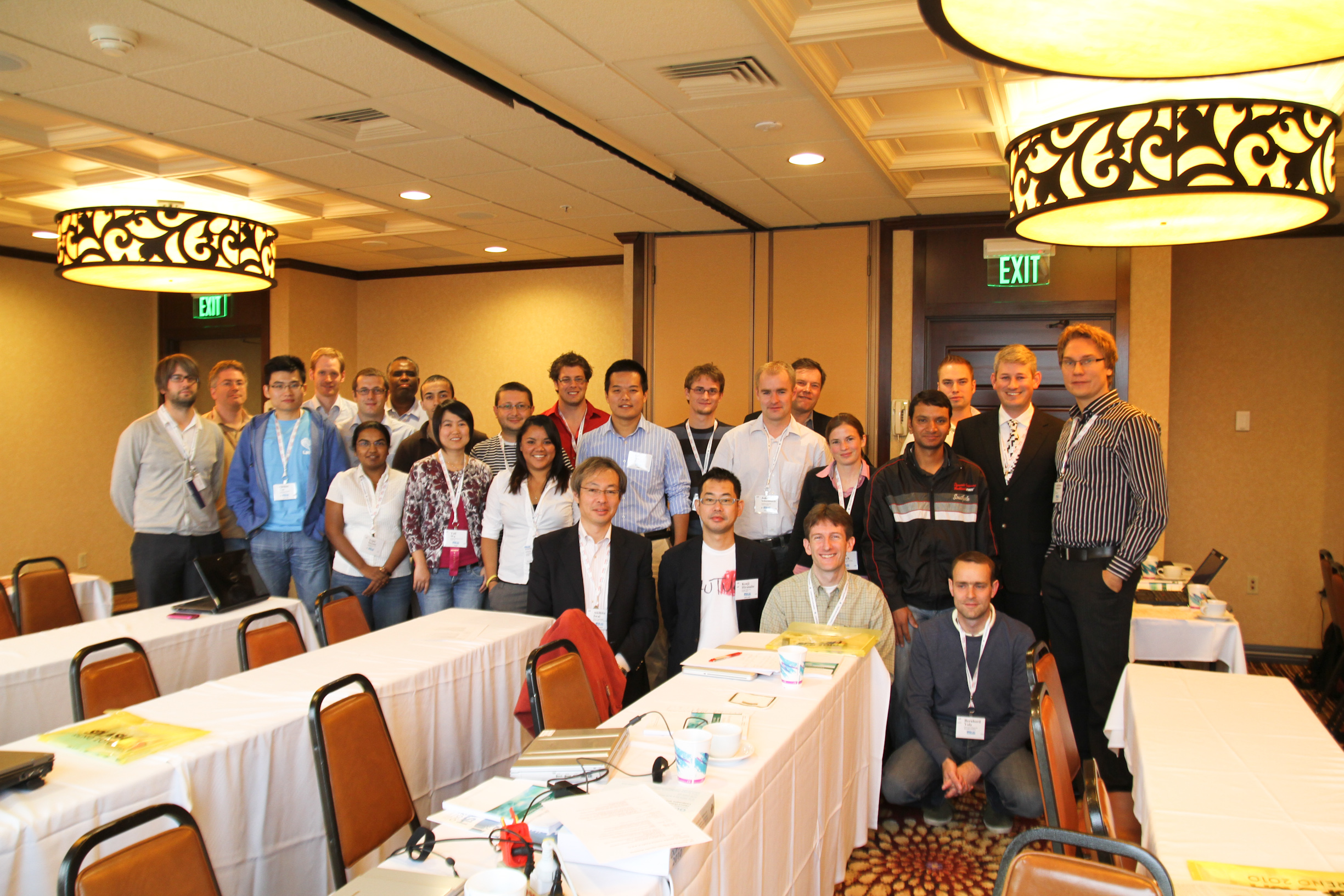
The workshop format is a combination of presentations, discussion sessions, and group work on selected topics. This structure was found effective during the past workshops. Based on the review scores, papers were categorized into long and short presentation slots. A long slot is 30 minutes: 20 minutes to present plus 10 minutes for questions. A short slot is 20 minutes: 15 minutes to present plus 5 minutes for questions.
Sunday 17 October (Central Pacific A, B & C) |
||
| 8:30 | Introduction | |
Cases |
||
| (not present) | Eberos GML2D:
A Graphical Domain-Specific Language for Modeling 2D Video Games Frank E. Hernandez, Francisco R. Ortega |
|
| 9:00 | A Domain
Specific Language to Define Gestures for Multi-Touch Applications Shahedul Khandkar, Frank Maurer (presentation) |
|
| 9:20 | A DSML for
Mobile Phone Applications Testing Youssef Ridene, Nicolas Belloir, Franck Barbier, Nadine Couture (presentation) |
|
| 9:40 | Domain-specific
Modeling as an Enabling Technology for SMEs Donald Barkowski, Thomas Kuhn, Christian Schäfer, Mario Trapp (presentation) |
|
| 10:10 | Break | |
| 10:30 | Experiences with
Automotive Service Modeling Akihito Iwai, Norio Oohashi, Steven Kelly (presentation) |
|
| 10:50 | Towards an Open
Meta Modeling Environment Bernhard Volz, Stefan Jablonski (presentation) |
|
| 11:10 | Introduction to group work, workshop photo | |
| 11:20 | Group work | |
| 12:00 | Lunch | in groups |
| 13:45 | Group work | |
Transformations and testing |
||
| 14:50 | Plug & Play
Model Transformations - A DSL for Resolving Structural Metamodel
Heterogeneities Manuel Wimmer, Gerti Kappel, Angelika Kusel, Werner Retschitzegger, Johannes Schoenboeck, Wieland Schwinger (presentation) |
|
| 15:10 | Break | |
| 15:30 | A WYSIWYG Approach
for Configuring Model Layout using Model Transformations Yu Sun, Jeff Gray, Philip Langer, Manuel Wimmer, Jules White (presentation) |
|
| 16:00 | Towards
flexible and efficient model-based testing utilizing domain-specific
modeling Olli-Pekka Puolitaival, Teemu Kanstren (presentation) |
|
| 16:30 | Verification
and Validation in the Context of Domain-Specific Modelling Janne Merilinna, Juha Pärssinen (presentation) |
|
| 17:00 | First day ends | |
Monday 18 October (Central Pacific A, B & C) |
||
| 8:30 | Introduction for the second day | |
Language Design |
||
| 8:30 | Integrating
Models with Domain-Specific Modeling Languages Juha-Pekka Tolvanen, Steven Kelly (presentation) |
|
| 9:00 | Domain-Specific
Engineering of Domain-Specific Languages Raphael Mannadiar, Hans Vangheluwe (presentation) |
|
| 9:30 | Domain Specific
- a Binary Decision? Markus Voelter, Bernhard Merkle (presentation) |
|
| 10:00 | Break | |
| 10:20 | Analysis of a
Metamodel to Estimate Complexity of Using a Domain-Specific Language Jonathan Sprinkle (presentation) |
|
| 10:50 | Measuring the Effort
for Creating and Using Domain-Specific Models Yali Wu, Frank Hernandez, Francisco Ortega, Peter J. Clarke, Robert France (presentation) |
|
| 11:10 | Group work | |
| 12:00 | Lunch | in groups |
Tools and meta-metamodels |
||
| 14:00 | The GDSE
Framework: A Meta-Tool for Automated Design Space Exploration Tripti Saxena, Gabor Karsai (presentation) |
|
| 14:30 | Developing Domain
Specific Modeling Languages by Metamodel Semantic Enrichment and
Composition: a Case Study Luis Pedro, Matteo Risoldi, Didier Buchs, Vasco Amaral (presentation) |
|
| 14:50 | Conceptual
modeling using domain ontologies: Improving the domain-specific quality of
conceptual schemas Frederik Gailly, Geert Poels |
|
| 15:10 | Break | |
| 15:30 | Group work | Groups prepare their report |
| 16:00 | Group work reporting and discussion | |
| 16:50 | Closing | |
| 17:00 | Workshop ends | |
Last program update: 14th October.
The papers are published in printed proceedings and are also available online.